
Before I start this I want to warn my readers it is a VERY information and photo heavy entry so if you’re here for the pretty gravestone photos feel free to scroll down to the gallery at the bottom of the text and if you’re here for a good chunk of New England history just read on as I take you down this deep deep rabbit hole with me!
It’s funny, I have been loitering around the Newport area for a few years now and although I had always wanted to check out the local cemetery it took me this long to actually get there. But let me tell you it was WELL WORTH the wait! This was one of the most interesting cemeteries I have ever had the joy of wandering through and part of that is because it’s actually seven separate cemeteries that have bled into each other to make one massive burial ground that dates back to our earliest settlements. The oldest parts of the cemetery were founded in 1640 and the newest are from the present day. All together there are thousands of memorials here.
During the colonial era Newport RI was also our largest port, even bigger than Boston at the time, and as such it was always a thriving multicultural area. The cemetery very much reflects this with various sections dedicated to different cultures, religions, and ethnicities. Here you’ll find the country’s oldest Jewish cemetery which dates back to the colonial era and contains mostly a thriving multi-nationl seafaring community as well as God’s Little Acre which is the the largest (and possibly only) cemetery dedicated to both enslaved and free blacks, also of the colonial era. It was these 250 or so slate stones I had especially wanted to see because they are soooo rare, and such a precious historical archive of an otherwise silenced community whose contributions have been largely looked over.
And it’s not only me who recognizes the need to preserve this historic landmark. Intense efforts to restore and preserve what is left here have been underway since the early 1990’s and continue to this day. There were even three stones which were returned to the cemetery after being found in various residences around RI and Pennsylvania. What they were doing in Pennsylvania is a bit of a mystery but one of these stones belonged to a famous woman at the time – Duchess Quamino. Duchess was a woman of remarkable standing. She came to Newport aboard a slave ship as a child, having been born somewhere in Africa. She was then bought by the Channing family who utilized her as a maid and cook. While enslaved she somehow managed to get in the good grace’s of the white church the Channings attended and was able to start her own bakery and catering business becoming the US’s first successful female black business owner.
During this time she married a slave from a different household and eventually had at least four children. Her husband was able to win a lottery and obtain his own freedom but it seems Duchess may have already been a free woman by then. No records exist to show how this happened – if she bought her freedom with the money she made baking or if she was simply granted her freedom. Either way she continued her business and eventually became so famous she earned the moniker “Pastry Queen of Rhode Island” and her delicious baked goods were served to a visiting George Washington at least twice.
Also worth noting was possibly the country’s first professional black artist – Pompe Stevens – who was a stone carver and possibly the one responsible for the distinct black features on the cherub’s heads carved into the stones in God’s Little Acre. He was enslaved by the biggest stone carving family in town and we probably wouldn’t even have known he existed except he carved a beautiful stone for his brother, which he identified as such before signing. He signed two stones in all but likely did a lot more – especially considering how intricate and well-practiced his carvings on those two stones seem to be.
It was a deeply humbling experience to wander God’s Little Acre and come face to face with the bleak reality of slavery in the colonies. The stones were hard to read – “Beloved and trusted by his master” was probably the most cringe worthy phrase I found. And the stories were heartbreaking – stories of black children whose parents were tricked into sending them to America “for and education” and “a better life” but instead ended up here. Buried in a slave cemetery. It’s an ugly mark on our history but we do each of these people a grave injustice by looking away and forgetting their great contributions.
We moved on from here and just wandered about until we found ourselves at a different entrance. And it was there we realized there was a sign up offering a free cell phone guided tour if you could scan the code on the sign. We went for it. But I was getting low on battery and it took a ridiculous amount of steps to set up. The next part of our day was spent fast walking through the stones trying to identify which ones were important according to the tour map which was…. grossly inaccurate. It started off being a few stones away from what they were talking about but by the end it was A LONG WAY AWAY. But we’ll get to that.
There are a lot of notable people buried out here. Among them are a ton of congressmen, mayors, and governors, over 70 Revolutionary war soldiers, a whole section dedicated to Civil War casualties, veterans from every US war, at least 4 famous architects, Charles Bird King (a portrait artist known for painting Native Americans) William Ellery who signed the Declaration of Independence, August Belmont Jr who developed the IRT subway in NYC and the Cape Cod Canal, most of the stone carvers who were responsible for the slate stones, and Ida Lewis “the bravest woman in America” who manned the Lime Rock Light Station for 46 years after the official lighthouse keeper (her father and then mother) died. During this time she rescued at least 36 people from drowning with her first rescue at the age of 12 and her last at 63! Keep in mind lighthouse keepers were NOT obligated to save drowning shipwreck victims for one very good reason – generally shipwrecks were caused by bad weather, bad weather that could easily capsize a tiny rowboat. It was better to guard the light than risk death. But Ida did not feel this way and was known to “row better than any man.” She lived on her own in this badass life until her death of a stroke. Really a remarkable heroine.
And it was Ida Lewis’ stone we couldn’t find at the end of the tour so I will give you some hints. It’s in the same row of stones that face the road near one of the exits. You cannot miss it as it has a HUGE anchor on it.
And I must say that also geeked out hardcore knowing that a number of the stone carvers were buried here as well and a lot of the stones could be attributed to either various members of the Stevens family (which were the first gravestone carvers in Newport and maintained the business for six generations) one of their slaves Pompe Stevens, or John Bull who married a Stevens daughter and then led this INSANE drama filled life that started when his brother pissed away the family inheritance and he had to sell himself into indentured servitude. It gets worse. He was sold to his brother-in-law William Stevens. The two HATED each other because William did not buy his brother-in-law as an act of charity – he expected work from him! And for a while Bull did in fact work as an indentured servant at the stone carving business but this didn’t last terribly long before he got fed up with the situation and basically ran away taking a job at sea where he stayed on ship for years. When he returned William sued him saying he was in breach of contract and still was obligated to work for free for a few years. The courts favored with Bull and in retribution he started his own gravestone carving business right across the street in what seems to be a purely spite based decision. Bull was the most artistic and rebellious of the city’s stone carvers and his work seems glaringly obvious with their side facing facial portraits and he is responsible for a famous stone – that of Charles Bardin – which is known for its intensely blasphemous imagery – that of Moses (or God?) parting the Red Sea. VERY UNUSUAL FOR THE PERIOD. It’s one of a kind and why it was made is still very unclear.
Meanwhile the Stevens family (who began as masons) didn’t escape the colonial era unphased as one of the original brothers, Philip, was noted cryptically in one of the legers as being murdered. Nothing further is stated. A second brother James died at sea.
By this point I was super sunburnt, overheating pretty bad, and tired from the jog so I regret to admit I did not cross the street to check out the colonial Jewish cemetery but I will likely return at some point. Until then I hope this has been an enjoyable read! Happy travels all!


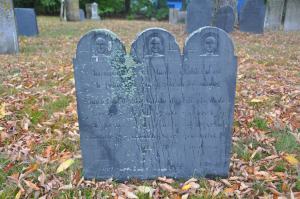 It’s the first day of October which means my favorite holiday of the year is coming up – Halloween. In celebration of this I have decided to make this month’s travels themed. So welcome to the first entry of my Haunted New England Tour! I will try my best to go to locations that are haunted, creepy, abandoned, surrounded by local myths and legends, stalked by cryptozoological beasts, or part of our brutal history. Of course there will be a number of cemeteries and this month could be a great way to get all you history and psychology buffs involved as New England is the site of many murders and mysteries! I shouldn’t have any problem finding new places to go!
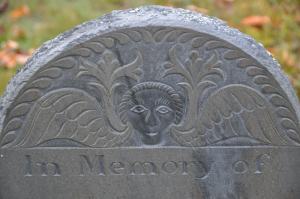 I am starting out with a familiar stomping ground for me – the graveyard behind the town common in Ashby. If you’re wondering what the difference between a graveyard and a cemetery is I am told cemeteries exist on their own while graveyards are consecrated ground adjoining a church. It took me way too long to figure out what this particular graveyard was called. I had to stare at Google street view for quite a while! But the Church is the First Parish Church (Unitarian Universalists) and the graveyard behind it is called
 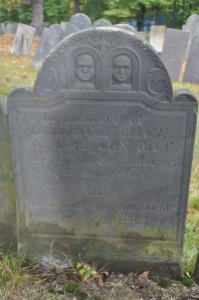 But anyway this cemetery is mostly slate stones which are the older stones you can find here, mostly dating to the 1700’s. These stones were particularly beautiful as they clearly had several different artists, all adding their own unique signature styles to familiar symbology. This was the first time I found a triple-headed stone. There’s usually one or two double-headed stones here and there, most often married couples or more grimly the gravesites of slaves, infants, or peasants (as double stones are cheaper than two separate stones…) From what I could guess these appeared to be siblings, all children, all dying in the third year of their life. Another sad find was a double stone for a twenty three year old woman in the late 1700’s who died four days after giving birth and one day after her infant died. Was this due to complications, disease, or a broken heart? We may never know but there did seem an inordinate amount of children here, even considering the time period.
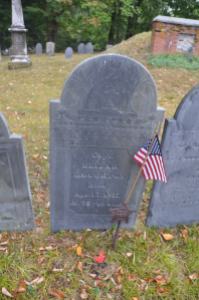 Because of its age this graveyard is littered with Revolutionary War soldiers. I have become accustomed to seeing their stones, usually easy to spot because of their metal war plaques and the small American flags that are placed at each. During my first visit here I noticed a very lonely little stone at the very back left corner. It was just a square marble post, looking more like a property marker than a gravestone. It was showered in pennies. In New England this is an old tradition that denotes respect for an important historical figure. Who could it be? I wandered closer and read the stone, “PRINCE ESTABROOK NEGRO GREATON’S CO. 3 MASS REGT REV. WAR.” I must admit this confused me greatly. Was Negro his last name or was he black? And if he was black… we had black revolutionary war soldiers?! I didn’t have a penny to leave that first time I visited but I did today and it seemed to mean a little more because I knew who it was now after looking his story up.
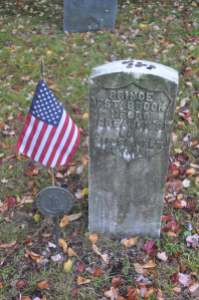 Prince Estabrook was indeed a black man and also a slave. On April 19, 1775, after requesting and being granted legal permission from his owner, he became the first black man to become a revolutionary war soldier (yes, I said first, not only.) He fought and was wounded in the battle of Lexington and Concord, the first battle of the Revolutionary War. His service was on and off from there until the end of the war. We know shockingly little other than that. We have no idea why he volunteered to fight for a country which was enslaving him, we have pretty much no details of his personal life, only that after he eventually won his freedom he lived in Ashby Massachusetts with the son of his previous owner, dying at around ninety years of age. He does not appear to have been honored in any special way during his life and on his death he was buried outside the graveyard’s official boundaries, forever segregated. This explains why his stone was so… isolated. It was moved at some point in recent history to at least be within the graveyard’s official grounds. Only in 2008 did he get recognition being mentioned on a memorial facing the Lexington Green where he fought.


