
Since I am in Maine I couldn’t ignore an opportunity to add to my Haunted New England Tour by taking a trip to Bucksport. Bucksport is an old coastal Maine town with a sordid history – or so some people believe.
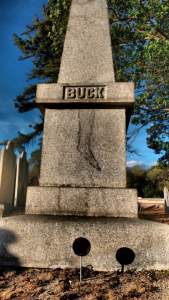 It all starts with Colonel Buck, one of the town’s founding leaders. I was told the story went something like this: A long time ago there was a mayor named Colonel Buck who had an illicit affair with a woman about the town and when she threatened to spill the beans about it he had her burned as a witch. As she was engulfed in flames her foot fell out of the fire, flopped onto the grave stone of her accuser, and made a permanent mark after she cried out some curse involving said foot. It’s a marvelous story. Gruesome, morbid, full of intrigue… and a complete lie. This had to have been made up by some bored parent one day teasing their children walking by the cemetery. Still, it attracts visitors from all over who come to gaze at Colonel Buck’s Tomb, which isn’t a tomb so much as a pillar shaped gravestone that was erected six decades after he died. He also wasn’t the mayor, he was a justice of the peace, and if he had any illicit love affairs they’re not on record and neither is there any record of any executions of witches in Maine. In fact the only witches put to death in all of New England were hung or pressed to death with stones, not burned alive. There’s a sign saying all this, basically a big ol’ bulletin that might as well read, “Y’all full of shit.” but hey if it’s real blood guts and gore you’re after there’s a much lesser known stone with a much truer story a few streets away.
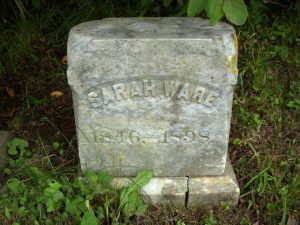 This is the stone of Sarah Ware. Her story is as weird as it gets up here in Maine. She was unusual in life because she was a divorced woman in the 1800’s, something pretty much unheard of. This had to have given her one hell of a stigma and maybe it was exactly that that got her killed. Life as a divorcee was not easy then and at fifty two years of age she was supporting herself by being a Jill of all trades babysitting, cleaning, and doing the odd job here and there. She was on her way home one evening when she disappeared. She was found two weeks later in a field viciously bludgeoned to death. She had been beaten so badly that when the body was removed her head fell clean off and her jaw was nowhere to be found. It was then kept as evidence as the rest of her was buried somewhere. Her head was kept in criminal storage as evidence for nearly a century before clerks discovered this gruesome artifact in 1983. The head was given a stone and laid to rest in the Oak Hill Cemetery, sans body.
So who killed her? Most believe it was the last guy to see her, William Treworgy, who had a long history of violence and probably didn’t want to pay her for whatever she’d done for him. They found a bloody hammer with his initials on it and aside from a confession that’s just about as good as forensic evidence gets at the end of the 1800’s. He was tried but it was years after her death and by then witnesses recanted or died. It was a hot mess. He got off. He probably would have gotten off regardless… I mean who cares enough about a divorcee to make sure she sees justice in 1898?? Sad but true. And that’s the true story of Sarah Ware, a largely forgotten figure far more interesting than the cock and bull story locals have made up about the witch’s foot… Did I mention the site where they found her body is now the high school’s parking lot? Sleep well kiddies. Sleep well.
If you are enjoying Catching Marbles please consider adding a dollar or two to my limited gas money fund so I can continue going on adventures and sharing them with you! Thank you!

 It’s the first day of October which means my favorite holiday of the year is coming up – Halloween. In celebration of this I have decided to make this month’s travels themed. So welcome to the first entry of my Haunted New England Tour! I will try my best to go to locations that are haunted, creepy, abandoned, surrounded by local myths and legends, stalked by cryptozoological beasts, or part of our brutal history. Of course there will be a number of cemeteries and this month could be a great way to get all you history and psychology buffs involved as New England is the site of many murders and mysteries! I shouldn’t have any problem finding new places to go!
 I am starting out with a familiar stomping ground for me – the graveyard behind the town common in Ashby. If you’re wondering what the difference between a graveyard and a cemetery is I am told cemeteries exist on their own while graveyards are consecrated ground adjoining a church. It took me way too long to figure out what this particular graveyard was called. I had to stare at Google street view for quite a while! But the Church is the First Parish Church (Unitarian Universalists) and the graveyard behind it is called
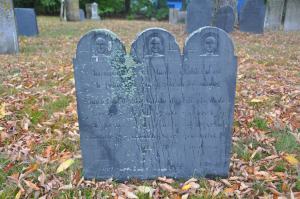
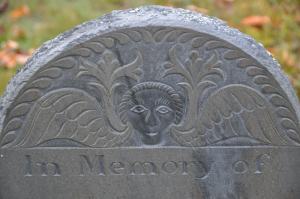
 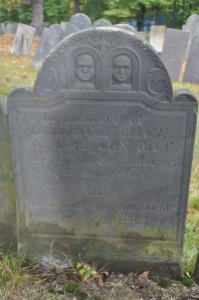 But anyway this cemetery is mostly slate stones which are the older stones you can find here, mostly dating to the 1700’s. These stones were particularly beautiful as they clearly had several different artists, all adding their own unique signature styles to familiar symbology. This was the first time I found a triple-headed stone. There’s usually one or two double-headed stones here and there, most often married couples or more grimly the gravesites of slaves, infants, or peasants (as double stones are cheaper than two separate stones…) From what I could guess these appeared to be siblings, all children, all dying in the third year of their life. Another sad find was a double stone for a twenty three year old woman in the late 1700’s who died four days after giving birth and one day after her infant died. Was this due to complications, disease, or a broken heart? We may never know but there did seem an inordinate amount of children here, even considering the time period.
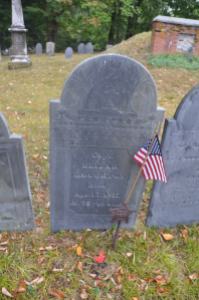 Because of its age this graveyard is littered with Revolutionary War soldiers. I have become accustomed to seeing their stones, usually easy to spot because of their metal war plaques and the small American flags that are placed at each. During my first visit here I noticed a very lonely little stone at the very back left corner. It was just a square marble post, looking more like a property marker than a gravestone. It was showered in pennies. In New England this is an old tradition that denotes respect for an important historical figure. Who could it be? I wandered closer and read the stone, “PRINCE ESTABROOK NEGRO GREATON’S CO. 3 MASS REGT REV. WAR.” I must admit this confused me greatly. Was Negro his last name or was he black? And if he was black… we had black revolutionary war soldiers?! I didn’t have a penny to leave that first time I visited but I did today and it seemed to mean a little more because I knew who it was now after looking his story up.
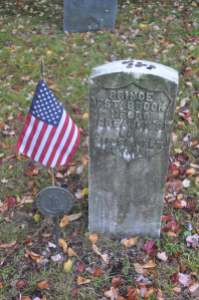 Prince Estabrook was indeed a black man and also a slave. On April 19, 1775, after requesting and being granted legal permission from his owner, he became the first black man to become a revolutionary war soldier (yes, I said first, not only.) He fought and was wounded in the battle of Lexington and Concord, the first battle of the Revolutionary War. His service was on and off from there until the end of the war. We know shockingly little other than that. We have no idea why he volunteered to fight for a country which was enslaving him, we have pretty much no details of his personal life, only that after he eventually won his freedom he lived in Ashby Massachusetts with the son of his previous owner, dying at around ninety years of age. He does not appear to have been honored in any special way during his life and on his death he was buried outside the graveyard’s official boundaries, forever segregated. This explains why his stone was so… isolated. It was moved at some point in recent history to at least be within the graveyard’s official grounds. Only in 2008 did he get recognition being mentioned on a memorial facing the Lexington Green where he fought.


